search world sports

Custom Search

Sunday, August 14, 2011

Maria Kirilenko Teeeis star hot pics

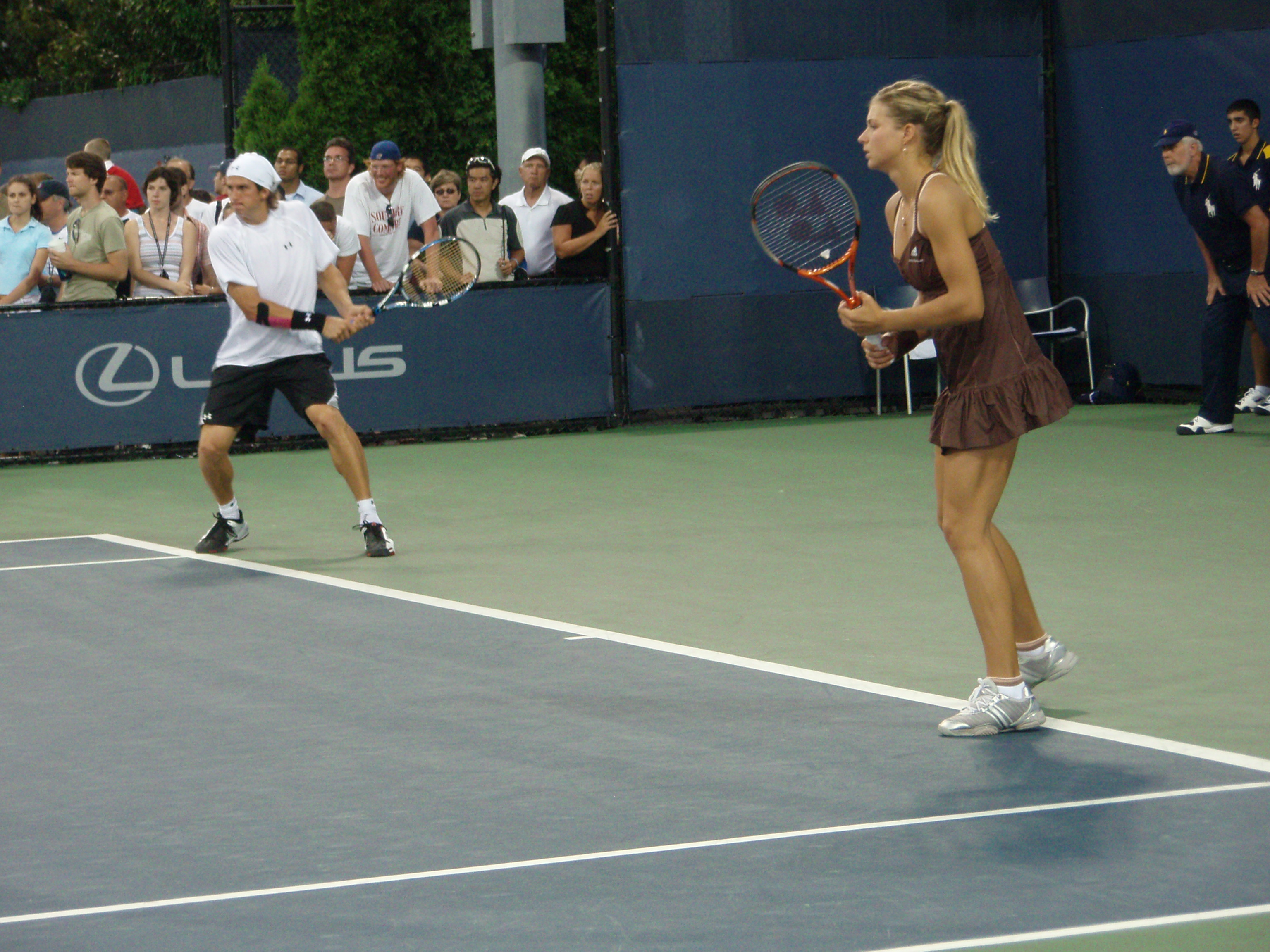
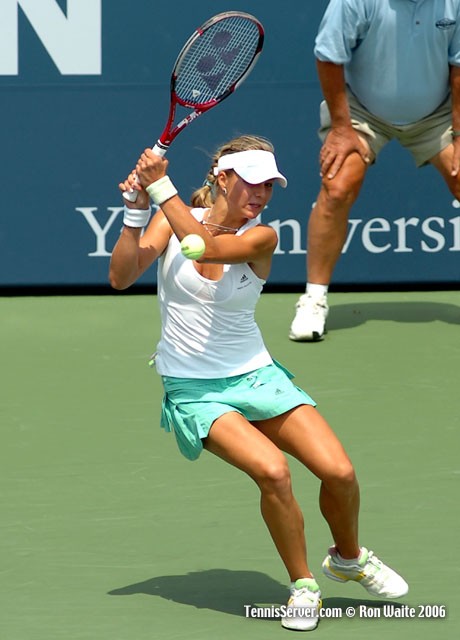
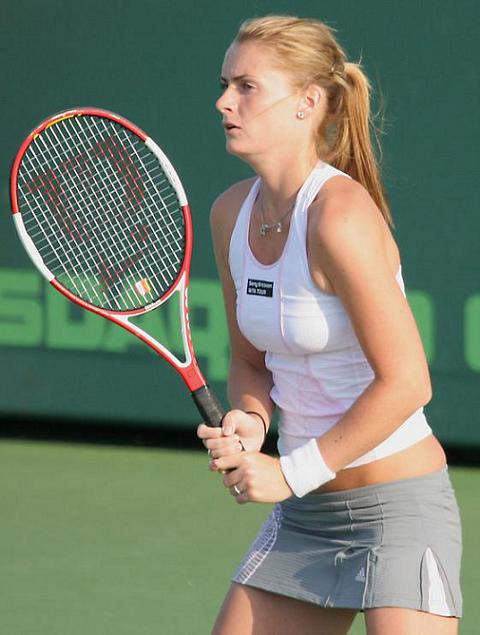
Maria Yuryevna Kirilenko born in Russian Moscow on 25 January 1987) is a Russian professional tennis player. Kirilenko won her first WTA Tour title in 2005, defeating Anna-Lena Grönefeld in the China Open. Kirilenko reached 18, her career-high singles ranking, on the WTA tour in July 2008.
2002, Kirilenko started participating in WTA events. She began moving up the rankings but was setback by an injury in 2004. At the end of 2005, she climbed back up the rankings and won her first title in Beijing.
in the 2010 ASB Classic were she reached the Quarterfinals, before losing to Shahar Pe'er. With a world ranking at that time of 58, Kirilenko was unseeded at the 2010 Australian Open where in the first round she upset her friend, and former doubles partner, number 14 seed Maria Sharapova 7–6(4), 3–6, 6–4 in a 3 hour, 22 minute marathon. It was the second longest women's match in Australian Open history. She advanced to the quarterfinals before losing to Zheng Jie who was also unseeded for this tournament. In the doubles portion, she and her partner, Agnieszka Radwańska, were seeded 15 and advanced to the semifinals before losing to the world number one pairing of Cara Black and Liezel Huber in three sets. At the Australian Open she failed to defend her quarterfinal points by being knocked out in the second round. However, in the doubles competition, she reached the final partnered with Victoria Azarenka but lost to Pennetta and Dulko. The Kirilenko/Azarenka team managed to win the Mutua Madrid Open. Kirilenko successfully defended her points earned from 2010 in the 2011 Wimbledon Championships by reaching the 3rd round, evenutally being stopped by the No. 7 seeded Serena Williams.

Maria Kirilenko
Maria Kirilenko
Maria Kirilenko

Maria Kirilenko
Maria Kirilenko
Maria Kirilenko

Maria Kirilenko wallpaper


Maria Kirilenko
Maria Kirilenko
Maria Kirilenko
Maria Kirilenko
Maria Kirilenko
Maria Kirilenko
Maria Kirilenko
Maria Kirilenko
Maria Kirilenko

Friday, August 5, 2011

Muhammad Ali boxer

Cassius Marcellus Clay, Jr., was born on January 17, 1942, in Louisville, Kentucky. The younger of two boys, he was named after his father, Cassius Marcellus Clay, Sr., who was named for the 19th century abolitionist and politician of the same name. His father painted billboards and signs, and his mother, Odessa Grady Clay, was a household domestic. Although Cassius Sr. was a Methodist, he allowed Odessa to bring up both Cassius and his elder brother Rudolph "Rudy" Clay (later renamed Rahman Ali) as Baptists. Olympic triumph, Clay returned to Louisville to begin his professional career. There, on October 29, 1960, he won his first professional fight, a six-round decision over Tunney Hunsaker, who was the police chief of Fayetteville, West Virginia.
Standing tall, at 6-ft, 3-in (1.91 m), Clay had a highly unorthodox style for a heavyweight boxer. Rather than the normal style of carrying the hands high to defend the face, he instead relied on foot speed and quickness to avoid punches, and carried his hands low. However, although he had an impressive record, he was not widely expected to defeat the champ. The fight was scheduled for February 25, 1964 in Miami, Florida, but was nearly canceled when the promoter, Bill Faversham, heard that Clay had been seen around Miami and in other cities with the controversial Malcolm X, a member of The Nation of Islam. Because of this, news of this association was perceived as a potential gate-killer to a bout which, given Liston's overwhelming status as the favorite to win (7–1 odds) had Clay's colorful persona and nonstop braggadocio as its sole appeal.
Faversham confronted Clay about his association with Malcolm X (who, at the time, was actually under suspension by the Nation as a result of controversial comments made in the wake of President Kennedy's assassination). While stopping short of admitting he was a member of the Nation, Clay protested the suggested cancellation of the fight. As a compromise, Faversham asked the fighter to delay his announcement about his conversion to Islam until after the fight. The incident is described in the 1975 book The Greatest: My Own Story by Ali (with Richard Durham).
Muhammad Ali
Muhammad Ali
Muhammad Ali
Muhammad Ali
Muhammad Ali
Muhammad Ali
Muhammad Ali
1970, while his case was still on appeal, Ali was allowed to fight again. On August 12, 1970, with the help of Leroy R. Johnson, a Georgia State Senator, he was granted a license to box by the City of Atlanta Athletic Commission. In Atlanta on October 26, 1970, he stopped Jerry Quarry on a cut after three rounds. Shortly after the Quarry fight, the New York State Supreme Court ruled that Ali had been unjustly denied a boxing license. Once again able to fight in New York, he fought Oscar Bonavena at Madison Square Garden in December 1970. After a tough 14 rounds, Ali stopped Bonavena in the 15th, paving the way for a title fight against Joe Frazier, who was himself undefeated.
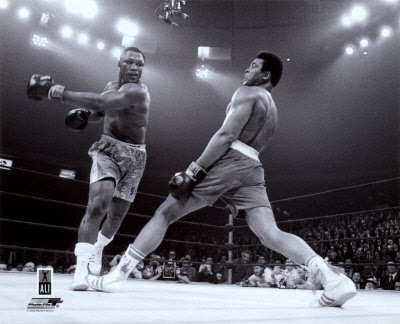
Ali and Frazier met in the ring on March 8, 1971, at Madison Square Garden. The fight, known as "The Fight of the Century," was one of the most eagerly anticipated bouts of all time and remains one of the most famous. It featured two skilled, undefeated fighters, both of whom had legitimate claims to the heavyweight crown. Frank Sinatra—unable to acquire a ringside seat—took photos of the match for Life magazine. Legendary boxing announcer Don Dunphy and actor and boxing aficionado Burt Lancaster called the action for the broadcast, which reached millions of people. a disease to which those subject to severe head trauma, such as boxers, are many times more susceptible than average. Despite the disability, he remains a beloved and active public figure. In 1985, he served as a guest referee at the inaugural WrestleMania event. In 1987 he was selected by the California Bicentennial Foundation for the U.S. Constitution to personify the vitality of the U.S. Constitution and Bill of Rights in various high profile activities. Ali rode on a float at the 1988 Tournament of Roses Parade, launching the U.S. Constitution's 200th birthday commemoration. He published an oral history, Muhammad Ali: His Life and Times by Thomas Hauser, in 1991. That same year Ali traveled to Iraq during the Gulf War and met with Saddam Hussein in an attempt to negotiate the release of American hostages. Ali received a Spirit of America Award calling him the most recognized American in the world. In 1996, he had the honor of lighting the flame at the 1996 Summer Olympics in Atlanta, Georgia.
The Muhammad Ali Center, alongside Interstate 64 on Louisville's riverfront
He appeared at the 1998 AFL (Australian Football League) Grand Final, where Anthony Pratt invited him to watch the game. He greets runners at the start line of the Los Angeles Marathon every year.
In 1999, the BBC produced a special version of its annual BBC Sports Personality of the Year Award ceremony, and Ali was voted their Sports Personality of the Century receiving more votes than the other four contenders combined. His daughter Laila Ali became a boxer in 1999 despite her father's earlier comments against female boxing in 1978: "Women are not made to be hit in the breast, and face like that... the body's not made to be punched right here [patting his chest]. Get hit in the breast... hard... and all that.

maria sharapova

Maria Sharapova was born in 1987 to Yury and Yelena, ethnic Belarusians, in the town of Nyagan' in Siberia, Russia.[citation needed] Her parents moved from Gomel, Belarus, after the Chernobyl nuclear accident in 1986 affected the region. When Sharapova was two, the family moved to Sochi, where her father befriended Aleksandr Kafelnikov, whose son Yevgeny would go on to win two Grand Slam singles titles and became Russia's first ever World No. 1 tennis player. Aleksandr gave Sharapova her first tennis racket at the age of four, whereupon she began practicing regularly with her father at a local park. With money tight, Yuri was forced to borrow the sum that would allow him and his daughter, neither of whom could speak English, to travel to America, which they finally did in 1994. Visa restrictions prevented Sharapova's mother from joining them for two years. Arriving in Florida with savings of US$700 Sharapova's father took various low-paying jobs, including dish-washing, to fund her lessons until she was old enough to be admitted to the academy. In 1995. Sharapova officially began her season at the Australian Open, where she was upset in her first round match that lasted more than three hours, losing 6–7(4), 6–3, 4–6 to Maria Kirilenko who reached the quarterfinals of the tournament. The loss meant that for the first time since 2003, Sharapova had lost her opening match at a Grand Slam event.
She then competed in the Cellular South Cup, where she reached the final and beat Sofia Arvidsson 6–2, 6–1 to win her 21st career WTA title and first of the year.
At the BNP Paribas Open, Sharapova lost in the third round 3–6, 6–2, 3–6 to Zheng Jie, aggravating a bruised bone on her right elbow in the process, which resulted in her eventual withdrawal from the Sony Ericsson Open, and the Family Circle Cup.
Returning at the 2010 Mutua Madrileña Madrid Open, Sharapova lost in the first round 4–6, 3–6 to Lucie Šafářová. She continued her French Open preparation at the Internationaux de Strasbourg as a wildcard. Sharapova advanced to the final where she beat Kristina Barrois 7–5, 6–1. This was her first title on red clay and 22nd overall title. Sharapova would bring in Thomas Hogstedt as a coach for the 2011 season, joining Michael Joyce. On December 5, Maria played an exhibition match against World No. 2 Vera Zvonareva in Monterrey, Mexico. She went on to win that match 6–1, 7–5.
Sharapova confirmed that her first tournament of the year would be at the 2011 ASB Classic in Auckland, New Zealand, held from January 4 to 9. She also announced that she would be leading the Russia Fed Cup team against France in February in their first-round tie.
In her first ever official Australian Open warm-up tournament at the 2011 ASB Classic in Auckland, New Zealand, she was seeded 1st. Sharapova was defeated in the third round by the Hungarian veteran and eventual champion Gréta Arn, 2–6, 5–7. After the ASB Classic Sharapova decided to take a hiatus from Joyce's coaching, despite having worked together for a number of years including during her successful years where she became a multiple grand slam champion.
Sharapova participated in the first grand slam of the season at the Australian Open, where she was the 14th seeded player. She made it to the fourth round, where she was unable to find consistency leading her loss to Andrea Petkovic 2–6, 3–6.
maria sharapova
maria sharapova
maria sharapova
maria sharapova
maria sharapova
maria sharapova
maria sharapova

Maria sharapova hot pics and wallpapers

Maria sharapova
Maria sharapova
Maria sharapova
Maria sharapova
Maria sharapova
Maria sharapova
Maria sharapova
Maria sharapova
Maria sharapova
Maria sharapova

Friday, July 29, 2011

Iveta benesova Tennis star hot pictures & wallpapers

Iveta Benešová (born on 1 February 1983 in Most, Czechoslovakia) is a professional tennis player. She began playing tennis at age of 7 and turned professional in 1998 in Prague. She has won two WTA Tour events2006–2008. the 2006 Australian Open, for the first time, she reached the third round of a Grand Slam by beating 5th seed Mary Pierce 6–3, 7–5. She lost in the next round 6–4, 6–1 to former No.1 Martina Hingis. Entering as a qualifier in the 2008 French Open, she reached the third round, beating 15th seed and compatriate Nicole Vaidišová 7-6(2), 6-1 in the first round, and losing to compatriate Petra Cetkovská 6-3, 6-3.
Benešová started the year by playing the first edition of the Brisbane International. She lost in the first round to qualifier Sesil Karatantcheva, 1–6, 6–4, 6–2. A week later, Benešová lost in the final of the tournament in Hobart, Australia to fellow-Czech Petra Kvitová.

At the Australian Open, Benešová lost in the second round to eventual semifinalist and fourth-seeded Elena Dementieva 6–4, 6–1.
Immediately after the Australian Open Series, Benešová played in front of her home crowd in the Fed Cup tie against Spain. Despite losing her singles rubber to Nuria Llagostera Vives 1–6, 6–1, 6–4, the Czech team advanced to the semifinals after winning the tie 4–1. World No. 1 Serena Williams 6–1, 6–4. Benešová then reached the semifinals of the the tournament in Acapulco, a clay court event. In the quarterfinals, Benešová beat Mathilde Johansson 6–1, 6–3 before losing in the semifinals to defending champion Flavia Pennetta 6–3, 6–3.
On 6 April 2009, Benešová achieved her career-high singles ranking of World No. 25.

At the 2009 Wimbledon Championships, Benešová beat Britain's Katie O'Brien in the first round, before falling to Jelena Janković in the second round.
In singles, she defeated Romanian Simona Halep 6-4, 6-2 in the final of 2010 Grand Prix SAR La Princesse Lalla Meryem to win her first WTA Tour trophy since 2004. Along with Barbora Záhlavová-Strýcová, she grabbed the titles in Paris as their opponents Cara Black and Liezel Huber withdrew and Monterrey defeating Anna-Lena Grönefeld and Vania King.

Iveta benesova

Iveta benesova

Iveta benesova

Iveta benesova


Iveta benesova

Thursday, July 21, 2011

serena williams world top ranking tennis star wallpaper gallery

serena williams wallpaper gallery
serena williams hot wallpapers

serena williams wallpaper

serena williams best wallpapers

serena williams


serena williams top star wallpapers

LinkWithin

Related Posts Plugin for WordPress, Blogger...